The oracle was fine. The collateral was not.
On 1 July 2026, Edel Finance's V1 lending deployment issued borrowing capacity against collateral that did not exist. The price feed behaved. Alphabet stock was quoted at roughly what Alphabet stock was worth. The break happened one step later, in the conversion between a tokenised equity and its wrapped form, and it valued the attacker's collateral at about 78 times its real value.
A correct oracle and an unsafe price
This is the part worth sitting with. The incident was not reported as a compromise of the underlying Chainlink Google feed. The external price stayed around the correct market level throughout. What the attacker targeted was the internal exchange rate between GOOGLx, a tokenised Alphabet equity asset, and wGOOGLx, its wrapped form.
The lending engine never consumed the external price directly. It consumed the wrapper-derived collateral value, and that value was manipulable. Public analysis puts the wrapper exchange rate moving from roughly 6 to nearly 79 over the course of the attack, producing the ~78× overvaluation and leaving approximately $403,000 in protocol bad debt.
The attack path
- Temporary capital: roughly 180,000 USDC drawn as a Morpho flash loan, enough liquidity to run the manipulation and the borrowing inside one atomic transaction
- Internal rate manipulation: repeated interaction with the wrapper pushed the wGOOGLx to GOOGLx conversion rate from roughly 6 to nearly 79
- Phantom collateral: wGOOGLx now appeared to represent far more underlying value than it did, so the lending engine calculated excessive borrowing capacity
- Multi-asset borrowing: USDC and several wrapped tokenised-equity assets drawn against it, including exposures linked to SPY, QQQ, MSTR, NVDA and TSLA
- Bad debt: once the flash loan was repaid and the manipulated valuation normalised, the positions were left substantially undercollateralised
Incident facts
- Network: Ethereum mainnet, Edel Lending V1
- Incident date: 1 July 2026, block 25,434,062
- Flash-loan source and size: Morpho, approximately 180,000 USDC
- Manipulated collateral: wGOOGLx, against underlying GOOGLx
- Collateral inflation: approximately 78×
- Reported protocol bad debt: approximately $403,000
Some incident databases report a lower direct asset-drain figure. This write-up uses the protocol-level bad-debt number throughout for consistency.
What a monitor should be watching
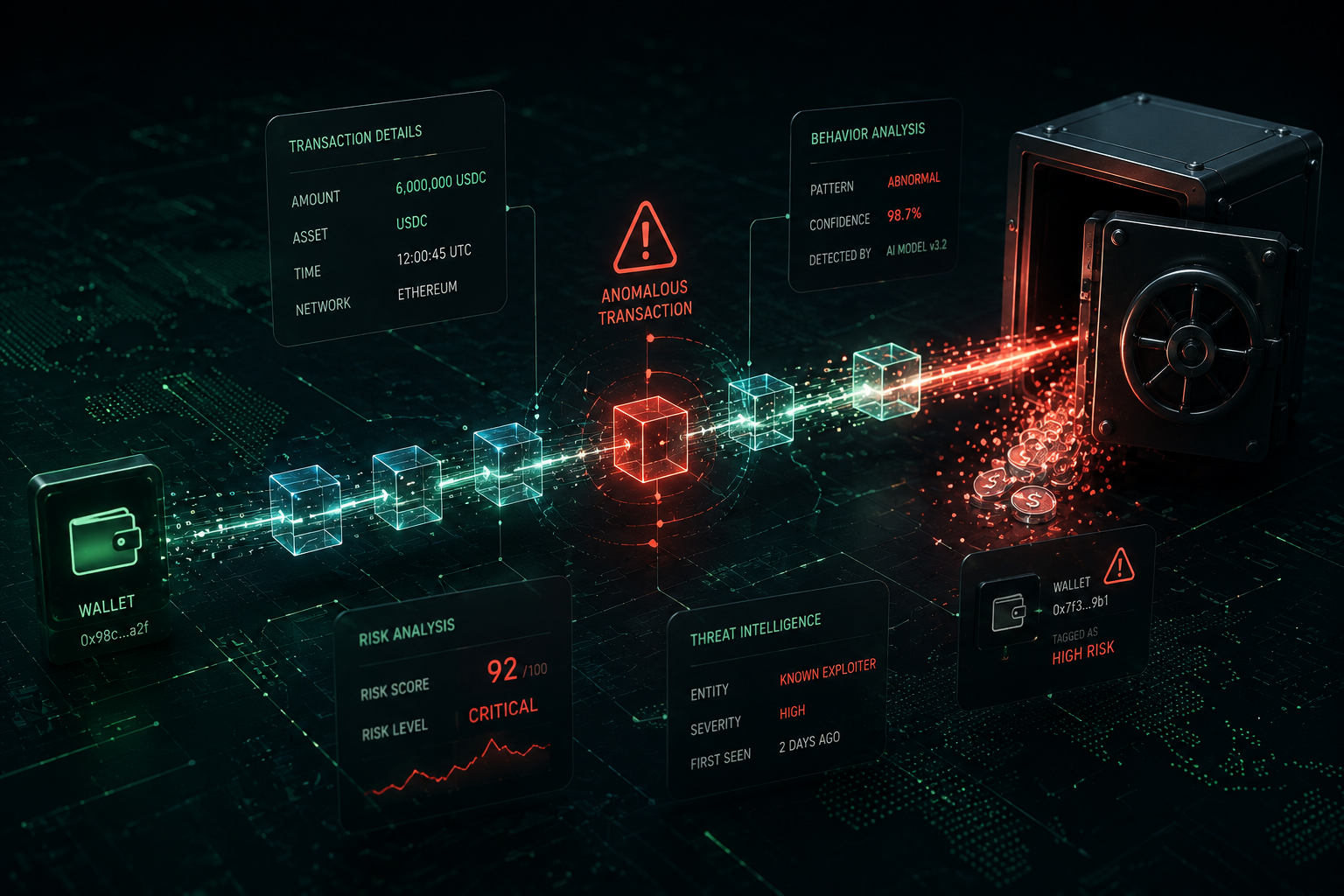
The detection idea is that the whole valuation path is in scope, not just the oracle at the front of it. Six indicators carry most of the weight:
- Flash loan into wrapper interaction: large temporary liquidity immediately followed by wGOOGLx and GOOGLx activity
- Exchange-rate jump: an abrupt change in assets-per-share, convertToAssets, or the wrapper conversion rate
- Underlying price stable: wrapper value moving sharply while the external Alphabet price stays comparatively flat
- Donation or balance anomaly: direct transfers of the underlying asset materially altering the wrapper's value calculation
- Large borrowing after a valuation change: one address suddenly using inflated collateral to draw multiple reserves
- Atomic sequence: flash loan, manipulation, borrow and repayment all inside the same transaction
The strongest single signal is divergence between the external underlying price and the wrapper-derived collateral price. In Edel the external Google price was reported as correct while the internal wGOOGLx conversion rate was manipulated. A monitor that only checked the first would have reported everything normal.
The invariant to validate
Borrowing power should stay economically backed by the real value of the collateral. When the protocol-reported collateral value becomes many multiples of an independently calculated value, that is not a risk score to weigh. It is an invariant that has broken, and it warrants a high-risk alert on its own.
Correlating around it gives the higher-confidence picture: temporary liquidity source, wrapper manipulation, collateral valuation change, large borrow, flash-loan repayment. The relationship between those events says more than any of them individually.
Turning the alert into a control
In a lending environment, detection on its own arrives too late. The practical model is to wire the signal into a risk-control decision wherever the client architecture supports enforcement:
- Borrow circuit breaker: restrict borrowing against the affected collateral when its conversion rate exceeds a defined deviation threshold
- Collateral quarantine: block new positions using the suspicious wrapped asset until valuation is independently verified
- Rate-change threshold: require manual or secondary validation for extreme single-block exchange-rate changes
- Flash-loan correlation: raise severity when an abnormal rate change lands in the same transaction as a flash loan and a large borrow
- Independent valuation: compare the wrapper-derived value against an external price and a conservative conversion model
- Rapid escalation: push a critical notification carrying transaction hash, attacker address, collateral, borrowed assets, and estimated exposure
How Edel responded
Edel paused V1 after containment, stated it would absorb the loss and restore affected balances one to one, and announced a redesigned V2 pricing architecture. The root issue was named plainly: a manipulable internal exchange rate between wGOOGLx and GOOGLx, with the external oracle reported as functioning correctly.
Controls worth carrying forward
- Do not treat a raw ERC-4626-style share or exchange rate as an independent oracle
- Monitor direct asset donations and their effect on assets-per-share
- Apply conservative borrow caps to thin-liquidity or wrapped collateral
- Run independent valuation checks before granting large borrowing capacity
- Require secondary validation for extreme single-block price or conversion changes
- Correlate flash loans, valuation changes, borrowing and asset outflow into one risk decision rather than four separate alerts
A correct external price feed does not guarantee a safe collateral valuation. The attacker exploited the transformation between the underlying token and its wrapped form, turning a normal market price into an unsafe collateral price.
This case study is based on publicly available reporting on the Edel Finance incident. The detection and prevention workflow described is a mapping of the incident onto Chain Monitor's detection concepts, not a claim that Chain Monitor was deployed on Edel Finance at the time of the original incident.
Written by
C’ROC Threat Research
Keep reading
Related reading


Security operations
around the world.
No matter where your team or your customers are, someone at C’ROC is already watching.
Book a Demo